



Your first big retail launch: where the cash goes in the first six months
15 min read
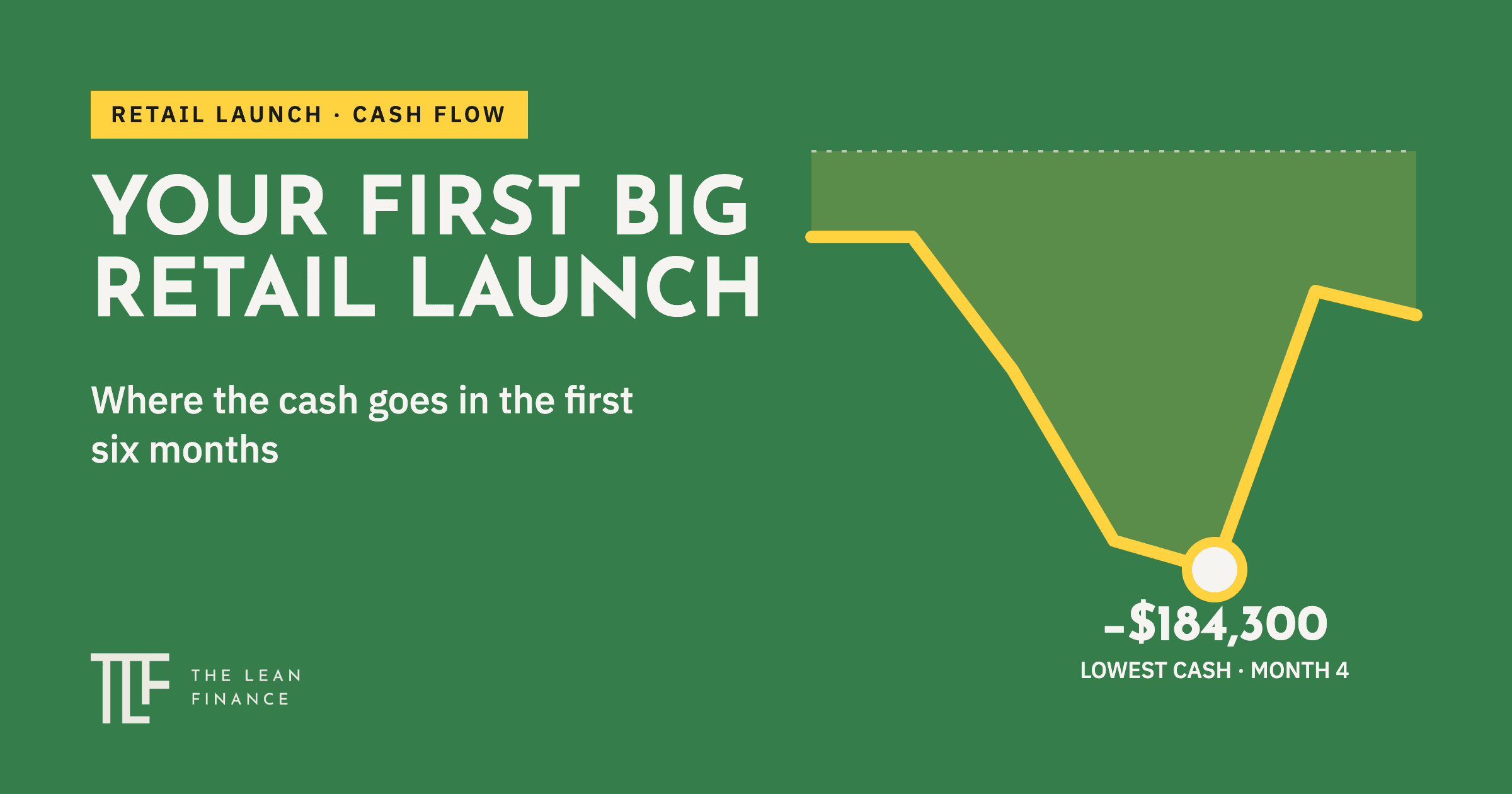
Landing Target or Ulta is a huge win.
For your cash, though, it’s the starting line, not the finish line.
A big retail launch is a cash event before it’s a revenue event. Money goes out in stages, months before any comes back. And when it does come back, chargebacks and deductions have often come off the top.
In this guide, I’ll follow the cash through your first six months, stage by stage:
- What do you pay before the first unit sells?
- How long is the gap between paying suppliers and getting paid?
- What are chargebacks in retail, and why is your first payment smaller than your invoice?
- Why does the reorder cost you cash before the launch has paid back?
- How much cash does a 600-door launch really tie up?
- What should you track every week?
Target Beauty Studio opened on September 10 in more than 600 stores, with about 90 brands. More than two-thirds of them are new to Target.[1] That’s almost exactly the size of the launch in this guide.
If you launched in Target Beauty Studio or at Ulta this fall, this is happening to you now. Between November and January, the first reorder is due, the first payments arrive smaller than your invoices, and you start paying for price cuts on slow sellers.
I see this pattern with the beauty brands I work with. And it starts before you’ve sold a thing.
Where the cash goes before the first unit sells
The purchase order feels like money coming in.
It’s actually money going out. A lot of it leaves long before the retailer pays you anything.
Here’s what usually leaves your account first:
- Production deposits. Most manufacturers want 30 to 50% upfront. The balance is often due before the goods ship.
- Minimum order quantities. Your manufacturer’s minimum is often bigger than the retailer’s order, so you pay for stock you can’t ship yet.
- Packaging and components. Bottles, cartons and printed boxes come with their own minimums and lead times.
- Retailer-specific packaging and labeling. New barcodes, carton labels or packaging changes. They must follow the retailer’s rules for suppliers, called the vendor guide.
- Freight. Inbound to your warehouse or 3PL, then out to the retailer’s distribution centers.
- Launch media. Some retailers ask you to commit an ad budget on their own platform at launch.
Then there’s the cost of getting on the shelf.
In grocery, it’s called slotting and free fills. In beauty, it looks like a discount on your opening order, plus testers and fixtures you pay for yourself. Different names, same effect: product and money you give away to launch.
Say the retailer wants one tester per SKU per store. Five SKUs in 600 doors is 3,000 units of free product before you’ve sold anything, and before your first reorder.
Free product is SKUs times doors, so do that math before you agree to the door count.
Here’s what that can look like. Take a launch of five SKUs in 600 doors, with an opening order of six units per SKU per store. That’s 18,000 units on the first purchase order.
| Cost | Assumption | Cash out |
|---|---|---|
| Production | 25,000 units at about $3 each (the retailer’s 18,000 plus your manufacturer’s minimum). 30–50% upfront, the rest before shipping | $75,000 |
| Retailer packaging and labels | Carton labels, barcodes, small packaging changes | $5,000–10,000 |
| Testers | 3,000 units at about $3 each | $9,000 |
| Fixtures (if required) | $50–150 per door | $30,000–90,000 |
| Freight | Inbound to your 3PL, then out to distribution centers | $5,000–15,000 |
| Launch media | First-month ad commitment on the retailer’s platform | $5,000–15,000 |
| Total cash out | $129,000–214,000 |
Illustrative numbers for a mid-size beauty launch, not a specific brand.
One more cost is easy to miss, because it never leaves your account: a 10 to 20% discount on the opening order. At a $10 wholesale price, you receive $18,000 to $36,000 less.
If you have a few hundred thousand dollars in the bank, that’s a big share of it. And it’s gone before the shelves are even stocked.
So that’s the money going out.
Now for the question that decides whether you can afford it: how long until it comes back?
Most founders guess 30 days. Counting from your first deposit, it’s usually closer to four to six months.
Retailer payment terms vs supplier terms
Here’s the cash gap in one line:
Your suppliers get paid before the goods ship. You get paid 30 to 60 days after the retailer receives them.
Finance people call this the cash conversion cycle. On a first launch, it’s long.
Real terms vary by retailer, and even by order. At one beauty brand I work with, Target pays on net 30. Walmart terms on the same account have ranged from about 40 to almost 100 days.
Here’s what it looks like for the 600-door launch above:
| When | What happens | Cash out | Cash in | Your running total |
|---|---|---|---|---|
| Month 0 | 40% production deposit, packaging and labels | $37,500 | –$37,500 | |
| Month 2 | Production balance, testers, freight to your 3PL | $59,000 | –$96,500 | |
| Month 3 | Delivery to the retailer, fixtures, freight, launch media | $75,000 | –$171,500 | |
| Months 3–5 | Retailer payment terms: net 30 to 60 | –$171,500 | ||
| Month 5 | First payment for the opening order, after the 15% discount | $153,000 | –$18,500 |
Illustrative numbers, using the middle of each range from the first table.
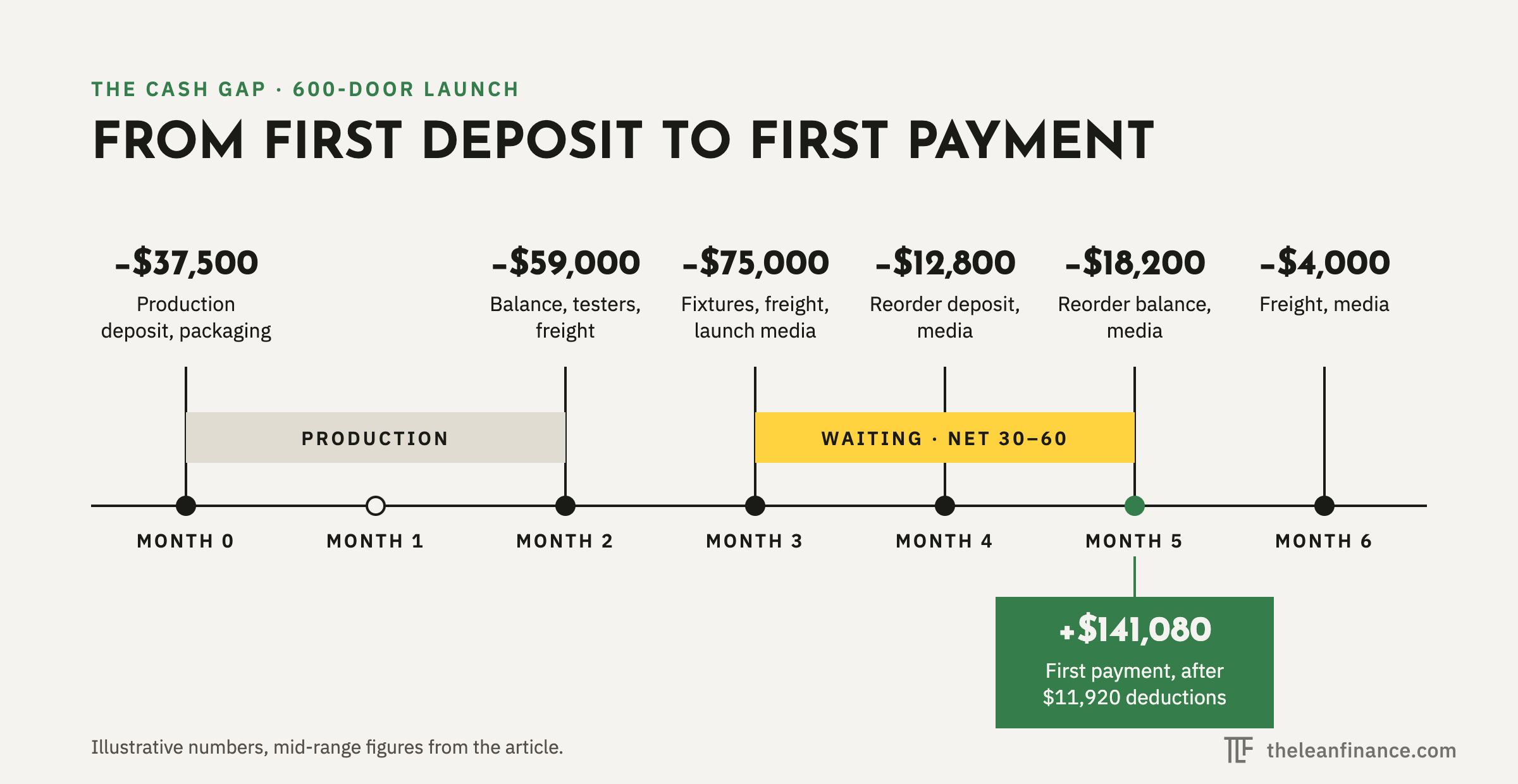
Look at the running total in the table. For about five months, you fund the launch from your own bank account. At its lowest point, that’s $171,500.
And even when the first payment lands, it doesn’t cover what you’ve spent.
A few things can shorten the gap:
- A smaller deposit, or the balance due on delivery instead of before shipping.
- Financing to bridge the months in between. It works, but it has a cost.
So you wait five months for $153,000.
But will $153,000 actually arrive?
Usually not. Some of it will be missing, with a reason code you may never have seen.
What are chargebacks in retail?
Here’s how two big beauty retailers handle it.
At Target, fines for late or incomplete shipments are a percentage of the cost of the affected units. A carton whose barcode won’t scan costs $0.75, with a $100 minimum.[3] Target updates its policy regularly. The 2026 version took effect on May 3. It added new checks, such as whether each case holds the units the purchase order says.[2]
Ulta notifies you first. Ulta waits 60 days before applying the chargeback to your invoice, which gives you time to dispute it.[4] Late deliveries cost $100 to $400 per purchase order once your on-time rate drops below 98%.[5]
Either way, the retailer’s systems check shipments automatically. Mistakes are most likely on a first launch, because your labels, EDI setup and often your 3PL are all new.
A chargeback doesn’t arrive as a bill. It arrives as money missing from your payment.
And the gaps spread across many invoices. When one beauty brand I work with shipped its first big Target order, it went out as about 30 invoices, one per distribution center, worth about $900,000 in total. One of those invoices, about $9,000, is still open 19 months later.
Here’s what that can look like on the first payment for our 600-door launch:
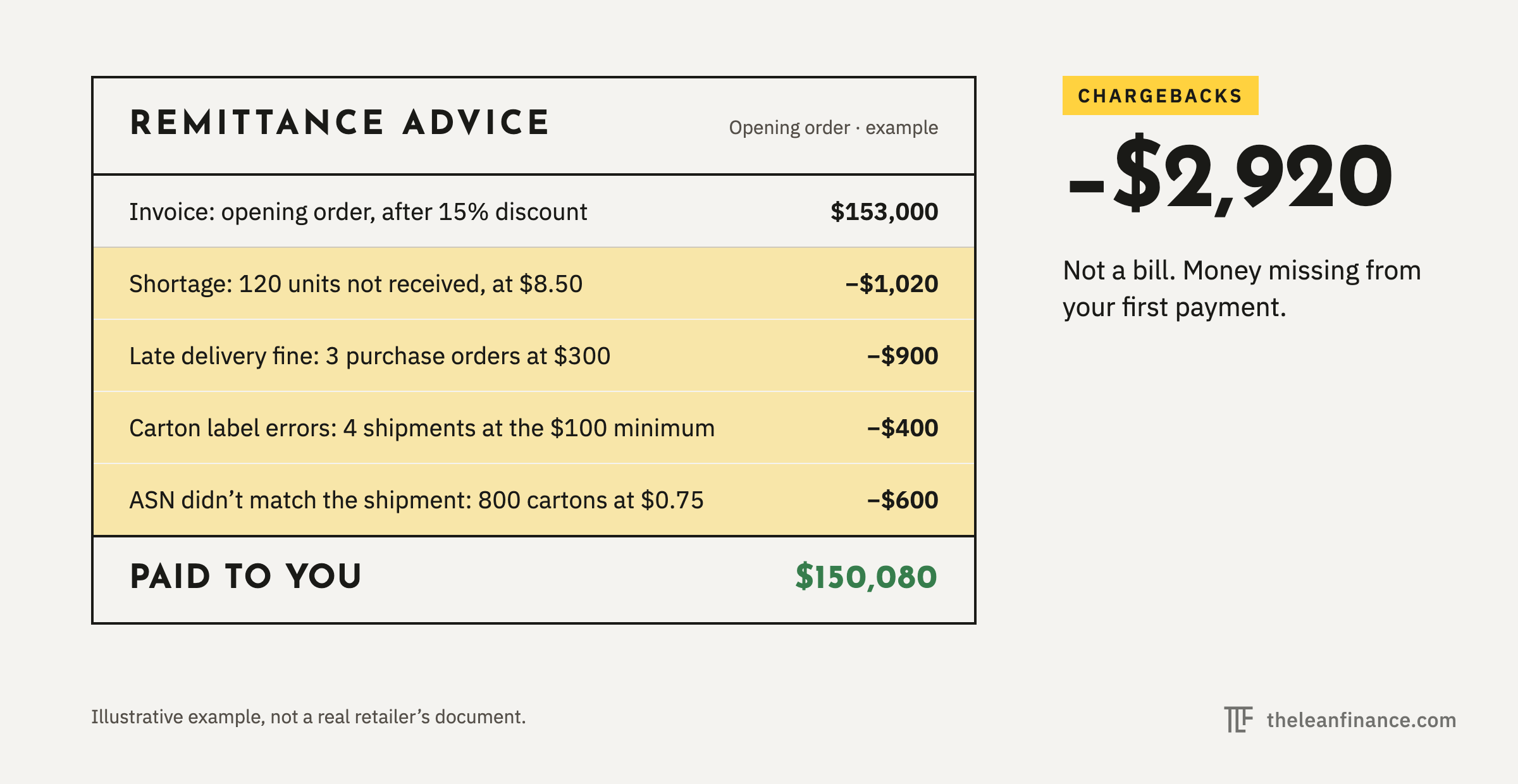
So that’s $2,920 gone to chargebacks. Annoying, but you can fix what causes them.
The bigger question: what else will the retailer take off your payments in the next few months?
Some of it, you already agreed to.
Retail deductions, markdown money and returns: the money you never see
Chargebacks are only one way money goes missing.
A deduction is any amount the retailer takes off what it owes you. Some are penalties. Many are costs you agreed to when you signed, like discounts, promotions and help with price cuts.
Industry studies put deductions at 5 to 15% of gross sales in consumer goods.[6] On a $180,000 opening order, that’s up to $27,000.
Real numbers can sit at the top of that range. At one multi-channel beauty brand I work with, chargebacks booked against wholesale sales came to about 15% over 21 months.
| Type | What it is | How it hits your cash | Can you dispute it? |
|---|---|---|---|
| Chargeback | A fine for breaking the vendor guide | Taken from a payment, or billed | Often, with paperwork |
| Deduction (short pay) | The retailer pays less than the invoice, with a reason code | A smaller payment, not a bill | Yes, if it’s wrong |
| Allowance | Agreed money off: opening order, damages, shared advertising | Off the invoice, or taken later | Only if it’s more than agreed |
| Markdown money | You pay part of the retailer’s price cuts on slow sellers | Taken from payments, often months after the sale | Rarely, because it’s negotiated |
| Returns | Unsold or damaged stock sent back | A credit, plus freight | Check the counts |
Most of these arrive long after the sale. A promotion you agree to in month 2 may come off a payment in month 5.
Your promo calendar is a cash calendar.
Plan the cash for a promotion on the day you agree to it, not on the day the retailer takes it.
In our example, you fund $1 off each unit during a promotion in month 3. The retailer sells 9,000 units on promotion and takes $9,000 from your month-5 payment.
And check every line. Some deductions are simply wrong, and they stay lost unless you dispute them. The fix is simple, if not exciting: keep the paperwork and dispute before the deadline.
So your payments are smaller than you planned. Meanwhile, the retailer wants more stock.
When is the reorder due? Usually before the opening order has paid for itself.
The reorder: the second cash hit
If the launch goes well, the retailer orders more.
That’s great news for sales. For cash, it means paying your manufacturer again, often in month 4, before the first payment has even arrived.
You pay that deposit while you’re still waiting for the $153,000 from the opening order.
A successful launch needs more cash, not less.
If the launch goes slowly, it costs cash in a different way. Retailers review their shelves regularly, at what’s called a reset. Slow sellers lose doors, and they often leave with returns or markdown money attached.
Either way, plan your cash for month 6, not just month 1.
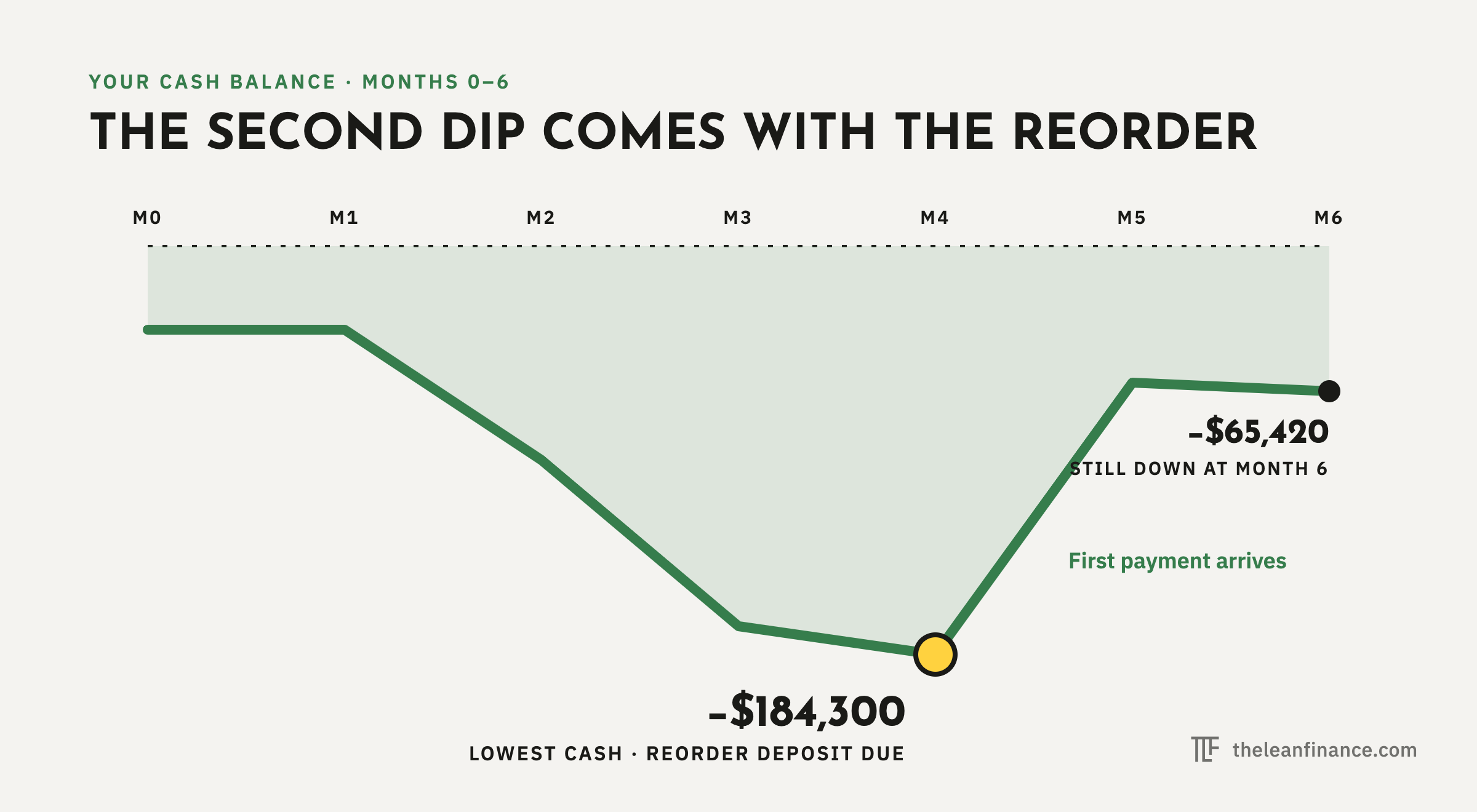
So how much cash does the whole launch tie up, month by month?
More than the $171,500 low point you saw earlier.
Worked example: a 600-door launch, month by month
Here’s the whole launch in one table, using the middle of each range from earlier.
| Month | Inventory and freight | Testers and fixtures | Retail media | Cash in | Deductions | Your running total |
|---|---|---|---|---|---|---|
| 0 | –$37,500 | –$37,500 | ||||
| 1 | –$37,500 | |||||
| 2 | –$50,000 | –$9,000 | –$96,500 | |||
| 3 | –$5,000 | –$60,000 | –$10,000 | –$171,500 | ||
| 4 | –$10,800 | –$2,000 | –$184,300 | |||
| 5 | –$16,200 | –$2,000 | $153,000 | –$11,920 | –$61,420 | |
| 6 | –$2,000 | –$2,000 | –$65,420 |
Illustrative numbers, not a specific brand. Deductions are the $2,920 in chargebacks plus the $9,000 promotion. Months 4–6 include the reorder.
Three things stand out:
- Your cash is lowest in month 4, at $184,300, not at launch.
- The first payment arrives $11,920 short, about 8% of the invoice.
- At month 6 you’re still $65,420 down. The reorder, worth $90,000 at wholesale, is on the shelf, but the retailer hasn’t paid for it yet.
Plan for your lowest cash point, not your launch date.
So the same month-6 number can mean a growing account or a closing one.
How do you know which one you have, before month 6? You watch five numbers every week.
What to track every week
You need five numbers, checked every Monday.
If one of these numbers moves the wrong way, you see it in week 3, not month 6.
That covers the system. A few questions come up in most first launches.
Common questions
What is the difference between a chargeback and a deduction?
A deduction is any amount a retailer takes off what it owes you. A chargeback is one type of deduction: a fine for breaking the vendor guide, such as a late shipment or a wrong carton label.
Other deductions, like promotions, markdown money and opening-order discounts, are costs you agreed to in advance.
Can you dispute a retail chargeback?
Yes, many of them, if you have the paperwork and act before the deadline. Keep the purchase order, packing list, ASN, carrier proof of delivery and photos of carton labels for every shipment.
Deadlines are short. At Ulta, you have 30 days after the payment notice to request a purchase order audit for a shortage, and the audit comes before any dispute.[4]
Who pays for a chargeback: the brand, the 3PL or the carrier?
The retailer takes it from the brand. Whether you can recover it depends on your contracts.
If your 3PL mislabeled the cartons or the carrier delivered late, your agreement with them decides who covers the fine. Check those terms before launch, not after the first short payment.
How much does a chargeback cost?
It depends on the retailer and the mistake. Target charges $0.75 per carton with a barcode error, with a $100 minimum.[3] Ulta charges $100 to $400 per purchase order when on-time delivery drops below 98%.[5]
How long until a retail launch pays back?
Longer than most founders plan. In the example above, the brand is still $65,420 down at month 6, even with a healthy reorder.
Payback depends on your margin, your payment terms and how fast reorders come. Model it week by week before you agree to the door count.
The short version
A big retail launch tests your cash before it tests your product.
Money leaves for months before any comes back. When it does come back, chargebacks and deductions have taken their share. And a good launch asks for more cash, not less.
Know your lowest cash point, and how you’ll fund it, before the purchase order arrives.
If you want a structured start, the 90-day finance setup builds your cash forecast, deductions log and weekly numbers with you.
And if your first retail launch is eating cash faster than it sells, book a call.
Sources
- FOX 29, “Target launches specialty beauty concept at stores nationwide as Ulta partnership ends,” August 31, 2026. fox29.com
- SPS Commerce, “Target Compliance Policy: A Credit Score for Suppliers,” updated September 10, 2026. spscommerce.com
- SupplyPike, “Physical Barcode Accuracy” (Target compliance fines). help.supplypike.com
- SPS Commerce, “Ulta’s Chargeback Program Explained.” spscommerce.com
- SPS Commerce, “Fulfilling Orders With Ulta’s Retail Calendar.” spscommerce.com
- Inmar Intelligence, “The Hidden Cost of CPG Chargebacks: What Manufacturers Overlook.” inmar.com
Client examples are from The Lean Finance client work, anonymised and rounded. Industry figures are estimates from the sources above.