



Aged inventory: how to find the cash trapped in your stockroom
12 min read
You know the stock is there. You can see the pallets at your 3PL and the units in Seller Central.
What’s harder to see is how much cash is sitting in them.
Aged inventory is cash you already spent. It’s stock that has sat unsold for months, usually more than 180 days. Every month it stays, it costs you storage, fees and margin.
When I started working with one multi-channel beauty brand, 56% of its inventory was aged. The brand had paid $1.4 million for that stock. At full price, it was about $5.7 million in sales it hadn’t made.
In this guide, I’ll show you how to find that cash and get it back:
- What is aged inventory?
- How much cash is trapped in it?
- What does it cost you every month?
- Why do multi-channel brands build so much of it?
- When is a discount cheaper than waiting?
- How do you release the cash without hurting the brand?
- How are excess, slow-moving and dead stock different?
- What should you track every month?
Start with where “aged” begins. It’s earlier than many founders think: Amazon starts charging extra at day 181.
What is aged inventory?
So now you know which units count as aged.
But how much money is in them?
Most founders count aged stock in units. Count it in dollars, and the picture changes.
How to calculate the cash trapped in your stock
Cash trapped = units in each age bucket × landed cost per unit.
Landed cost is what one unit cost you to get into your warehouse: product, packaging, freight and duties.
Pull the aging reports from Amazon (FBA Inventory in Seller Central) and from your 3PL. Group units by age bucket, multiply by landed cost, and add it up.
At the brand from the intro, nobody had done this before. Here’s what the reports showed for its 150 SKUs:
| Age bucket | Units | Cash paid ($5 landed cost) | Sales at full price ($20) | Share |
|---|---|---|---|---|
| 0–180 days | 225,790 | $1,128,950 | $4,515,800 | 44% |
| 181–270 days | 115,902 | $579,510 | $2,318,040 | 23% |
| 271–365 days | 117,890 | $589,450 | $2,357,800 | 23% |
| 366–455 days | 34,353 | $171,765 | $687,060 | 7% |
| 456+ days | 15,749 | $78,745 | $314,980 | 3% |
| Aged (181+ days) | 283,894 | $1,419,470 | $5,677,880 | 56% |
From one client's Amazon and 3PL aging reports, anonymised. Landed cost averaged at $5 per unit, full price at $20.
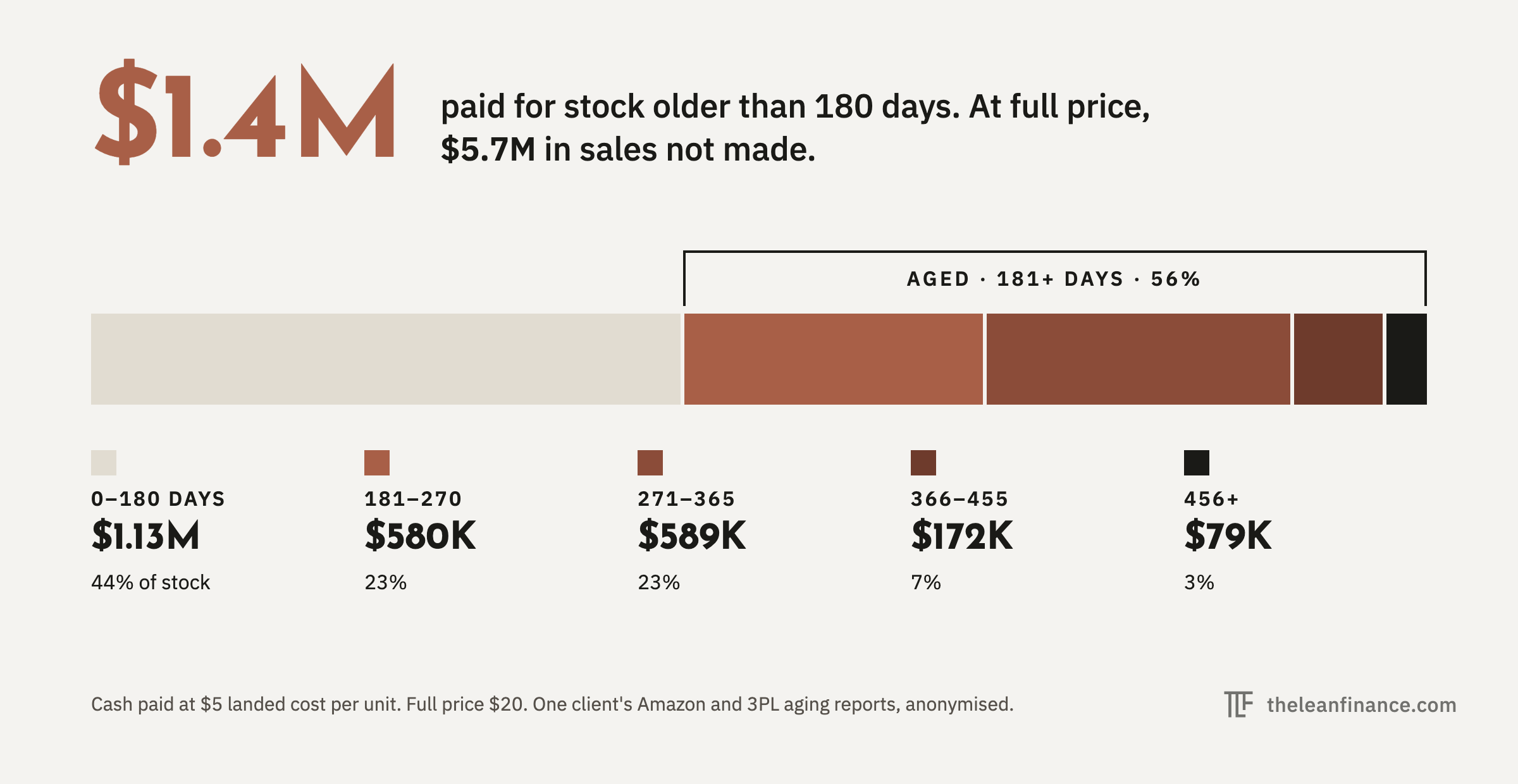
The brand had paid $1.4 million for stock worth $5.7 million at full price, and that stock was barely selling.
So $1.4 million was stuck.
Is that the full cost? No. Stuck stock also costs you money every month it stays. On Amazon, it pays twice.
What aged stock really costs
Holding stock costs about 20% to 30% of its value a year, by industry estimates.[1] On $1.4 million of aged stock, that’s roughly $280,000 to $430,000 a year.
That’s storage, Amazon fees, shelf life, write-downs, and cash you can’t spend on marketing.
Amazon charges extra for old stock
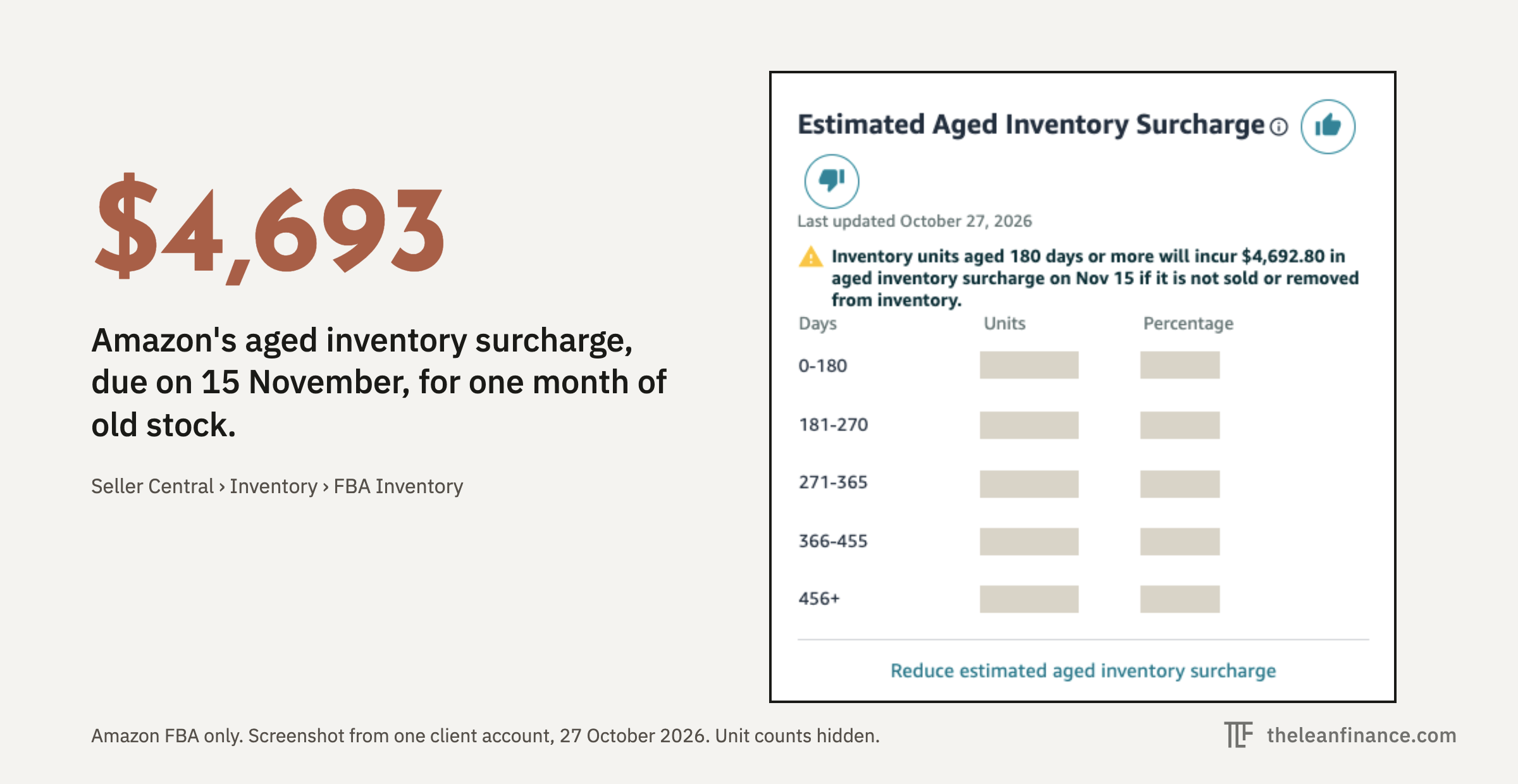
Amazon charges an aged inventory surcharge on units that have been in its fulfillment centers for 181 days or more.[2] You pay it on top of the normal monthly storage fee. Amazon checks inventory age on the 15th of every month, and the rate rises the longer a unit sits.
At one beauty brand I worked with, the surcharge reached about $5,000 a month. That’s $60,000 a year, paid on products nobody was buying.
On Amazon, each unsold unit past day 180 costs you twice: once for storage and once for its age.
Shelf life adds pressure too. US law doesn’t require expiry dates on cosmetics, but brands must know each product’s shelf life,[3] and customers check dates, especially on skincare.
What it does to your P&L
- Storage fees and Amazon surcharges lower that channel’s contribution margin: what’s left from each sale after product and channel costs.
- Write-downs happen when stock can’t sell above cost. The lost value becomes a cost, often in one large hit at year-end.
I try to avoid write-downs by releasing stock early. When one is necessary, take it on purpose, not by surprise in an audit.
So aged stock costs you every month. Why do brands keep building it, then?
In my experience, it’s rarely one bad forecast. Usually, something is missing rather than wrong.
Why multi-channel brands build aged inventory
At the 150-SKU brand, nobody owned inventory.
The team planned around holidays and celebrations. Each event got its own production run, and unsold units went back into storage.
Without an owner and a process, these drivers pile stock up:
- One forecast for every channel. Each channel sells at a different speed, so one forecast over-orders for the slow ones.
- Minimum order quantities (MOQs). Your manufacturer’s minimum is often more than you’ll sell in six months.
- Viral spikes. You reorder at the peak, and the stock arrives after demand has cooled.
- Seasonal sets and limited editions. They’re hard to sell once the moment has passed.
- Too many SKUs. Each new shade or size splits demand, and the long tail ages.
- Retailer decisions. A retailer cuts a slow SKU, and stock made in its packaging gets stuck. More on this in your first big retail launch.
Aged inventory usually comes from a missing process, not one bad decision.
So you know where it came from. What do you do with it?
The first instinct is a discount, and the second is to worry about margin. The math often says something different: 40% off today can be worth as much as waiting nine months for full price.
When is a discount cheaper than waiting?
Don’t compare the sale price with the full price. Compare cash now at a lower price with maybe cash later at full price, minus the cost of waiting.
| One aged unit | Sell now at 40% off | Wait for full price |
|---|---|---|
| Price | $12 | $20, if it sells |
| Chance it sells at that price | 100% | 60% within 9 months |
| If it doesn’t sell | – | Liquidated at about $5 |
| Holding cost while you wait | – | 9 months × $0.20 = –$1.80 |
| Expected cash per unit | $12.00, today | $12.20, in 9 months |
The two are about equal. One pays today, the other in nine months, maybe.
A discount is cheaper than waiting when the cash it frees is worth more than the full price you’re hoping for.
Run it for your biggest aged SKUs. A higher holding cost or a lower chance of selling makes the discount look better.
So a discount can make financial sense.
The real risk is to your brand. Discount in the wrong place, and full-price customers learn to wait for sales.
The answer isn’t a smaller discount. It’s a different place to sell.
Seven ways to release the cash
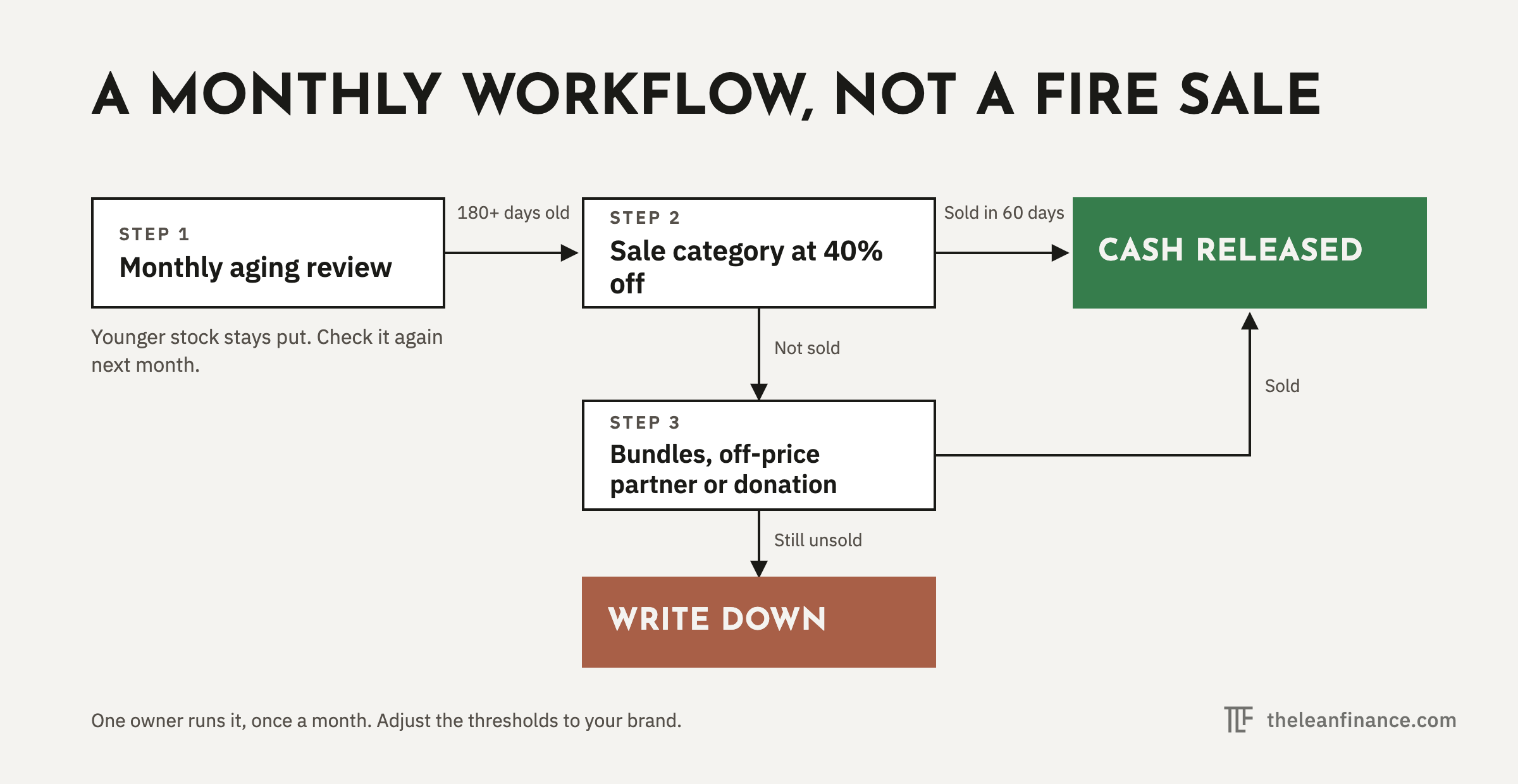
Most brands clear aged stock with a one-off flash sale. A better approach is a simple SOP: when stock counts as aged, who decides, and where it goes.
Aged inventory needs a workflow, not a fire sale.
1. Give aged stock its own sale category
Here’s what that workflow looked like at a luxury beauty brand I worked with.
The brand’s aged stock had expiry dates getting close, so it had to sell soon. But deep discounts on the main shop were not an option. For a high-end brand, a 40% off banner there tells every customer the full price was never real.
So we created a separate “Sale” category on the website. The rule was simple: after 180 days, a SKU moves there and sells at 40% off. If it hasn’t sold within 60 days, it moves on to bundles, an off-price partner or donation. The full-price range stays untouched.
The category found a new audience: shoppers who wanted the brand but couldn’t afford the full price. For them, it felt like a real find.
They kept coming back to the category. We cleared the aged stock in about two months, without discounting the brand itself.
2. Move aged stock out of Amazon
At the brand paying $5,000 a month in surcharges, we sent a removal order and moved the aged units to our 3PL. The 3PL charged no surcharge, and its storage was much cheaper.
That one change avoided more than $60,000 a year in surcharges. It also lowered the Amazon channel’s storage costs, so the channel became more profitable.
Two checks first. Amazon charges a removal fee per unit, and your 3PL charges to receive the stock. And don’t pull too much: under 28 days of supply, Amazon charges a low-inventory-level fee.[4]
Five more options
| Option | How it works | Cash back |
|---|---|---|
| 3. Bundles | Pair an aged SKU with a best-seller | Steady |
| 4. Channel-only promotions | TikTok Shop deals or creator campaigns for aged SKUs | Fast |
| 5. Off-price and liquidation | Sell large volumes to off-price stores or liquidators | Fast, at a low price |
| 6. Donation and samples | Donate to nonprofits such as Project Beauty Share, or use units as gifts and samples | None, but may lower tax |
| 7. Reorder freeze and SKU cuts | Check aged units before every reorder, and drop SKUs that keep aging | Stops new cash getting stuck |
Two of these need extra care.
Off-price and liquidation. We were careful here. Put resale limits in the contract, such as no Amazon. Prefer partners with their own stores or export markets, and watch your listings for new sellers.
Donation. Nonprofits such as Project Beauty Share pass beauty stock to people in need. It’s a good deed and a real story for your community. In the US, a C corporation donating inventory for the care of the ill, the needy or infants can deduct up to twice its cost. S corporations and partnerships usually deduct only the cost.[5] Check with your tax advisor first.
So you have seven options. Which one fits which stock?
That depends on what kind of slow stock you have. Excess, slow-moving and dead stock look alike in a report, but they need different fixes.
Excess vs slow-moving vs dead stock
| Type | What it means | Usual fix |
|---|---|---|
| Excess inventory | More units than you’ll sell in your planning window, even on a good SKU | Pause reorders, move stock between channels |
| Slow-moving inventory | Still sells, but far below plan | Bundles, channel promotions |
| Aged inventory | Unsold for more than a set number of days, usually 180 | Sale category, removal from Amazon |
| Dead stock | No realistic chance of selling above cost | Liquidate, donate, or write down |
Labels only help if someone checks them.
The fix takes less work than it sounds: one owner, six numbers, once a month.
What to track every month
If these numbers move the wrong way, you see it at day 150, not day 400.
To see what that does to your bank balance week by week, use a 13-week cash flow forecast.
A few questions come up with most brands.
Common questions
Is aged inventory the same as dead stock?
No. Aged inventory is defined by time in storage. Dead stock has no realistic chance of selling above cost. Aged stock becomes dead stock if nobody acts.
How do I avoid Amazon’s aged inventory surcharge?
Check FBA Inventory monthly for units approaching 181 days. Then promote them, bundle them, or move them to your 3PL with a removal order.
The short version
Aged inventory is cash you already spent, sitting in storage and costing you every month.
Find it by age bucket, put a dollar value on it, and build a workflow that moves it out early.
Measure aged inventory in dollars, not units, and review it every month.
For a structured start, my 90-day setup as a fractional CFO for beauty brands builds your inventory review and cash forecast with you.
And if you suspect cash is stuck in your stockroom but can’t see how much, book a call.
Sources
- OneCart, “Inventory Carrying Cost: Formula, Example & How to Reduce It.” Industry estimate. getonecart.com
- SupplyKick, “How to Avoid Amazon’s Long-Term Storage Fees.” supplykick.com
- U.S. Food and Drug Administration, “Do I need to label my cosmetics products with expiration dates?” fda.gov
- Feedvisor, “Amazon Seller Fees 2026: Complete Fee Breakdown Guide” (low-inventory-level fee). feedvisor.com
- RSM US, “Know the rules for tax deductions on charitable donations of inventory.” rsmus.com
- Amazon Seller Forums, FBA Inventory aged inventory surcharge guidance. sellercentral.amazon.com
Client examples are from The Lean Finance client work, anonymised and rounded. Industry figures are estimates from the sources above. Amazon fee rules change every year: re-check before each refresh.